Hi Fidelity Genealogy
If you've been working on your family tree for a while, you probably know the feeling of frustration when your software just doesn't do quite what you need it to do. Maybe it's great at finding census records, but it doesn't quite give you the flexibility you need to organize your evidence. Or maybe it builds beautiful charts, but lacks the smarts to help you decipher 18th-century handwriting.
To understand why this happens—and how to fix it—we need to take a quick trip back to the year 1984.
The Legend of the Stack System
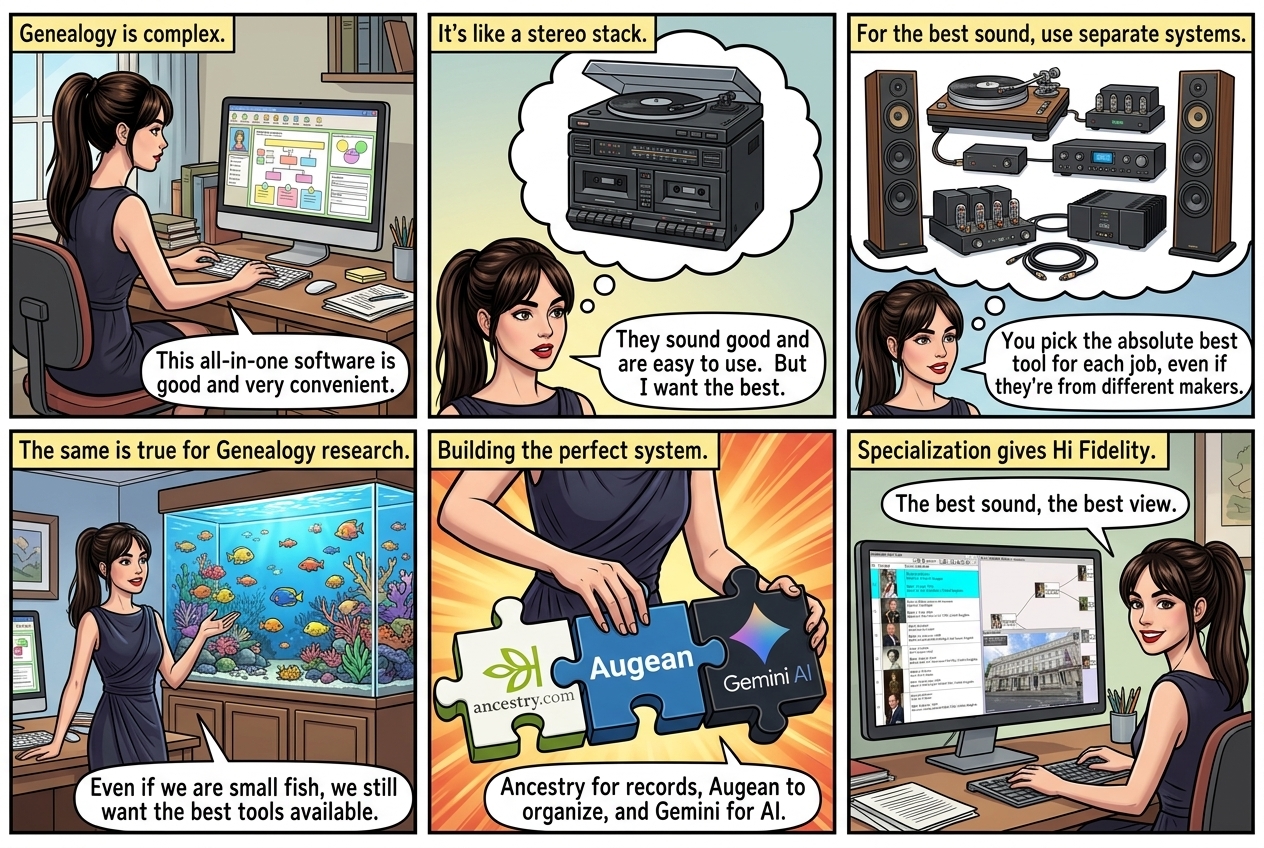
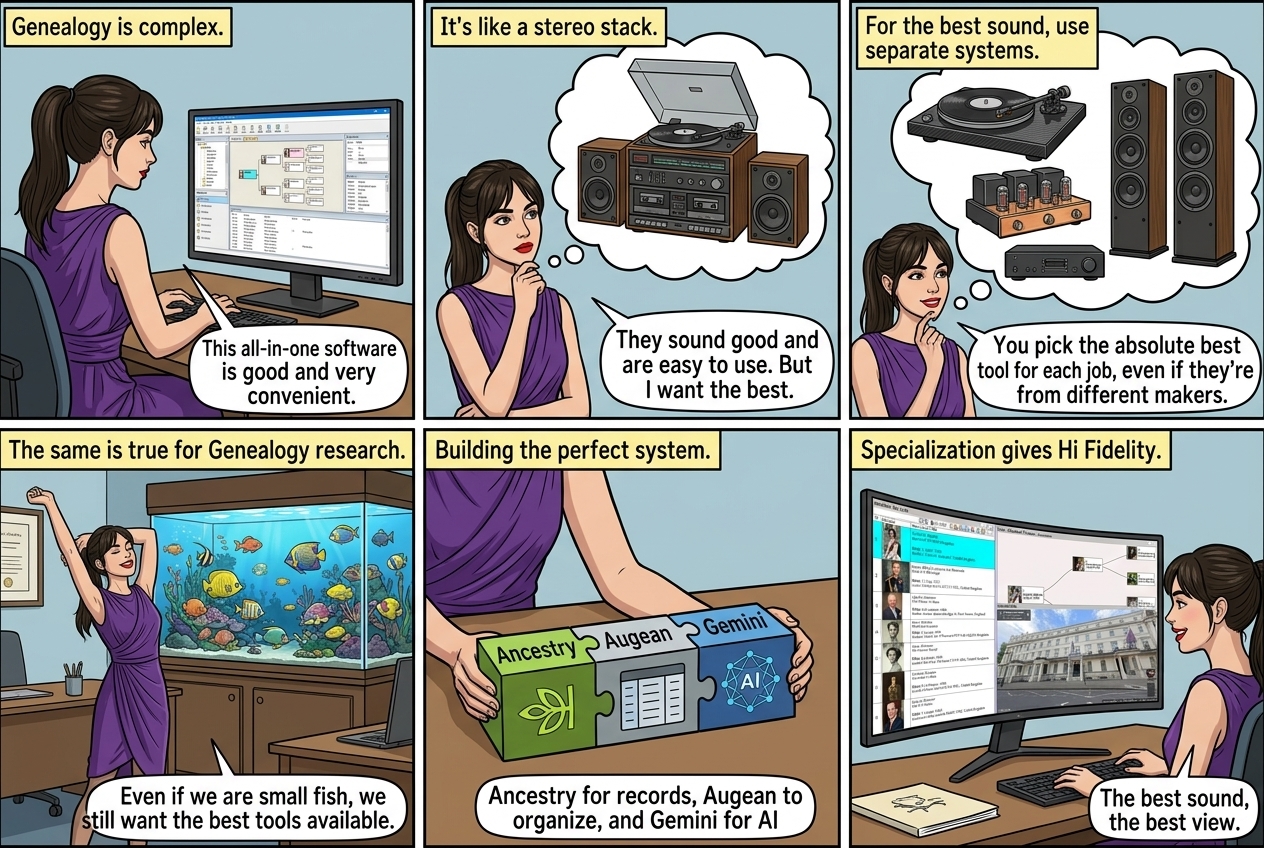
In 1984, I proudly brought home a brand-new "stack system" Hi-Fi. It was a massive, all-in-one monolith. Every single component—the turntable, the twin cassette deck, the amplifier, and the FM tuner—was manufactured by one company: Sentra. It looked incredibly neat, powered on from a single plug, and was marketed to beginners as the ultimate, hassle-free audio solution.
But then my friend, an unapologetic and highly discerning audiophile, came over to listen. He didn't mince words. He pointed out the muddy bass and the lack of clarity in the treble. "Stack systems are terrible," he told me flatly.
His logic changed the way I thought about technology forever: "A company trying to build every part of the chain will always compromise. You need a best-in-class system. You need the specific manufacturer who makes the absolute best component for each individual job."
He was absolutely right. The engineering required to build a powerhouse amplifier is entirely different from the delicate micro-mechanics needed to craft a high-end turntable stylus. By buying a stack system, I had traded excellence for the illusion of convenience. To achieve true high-fidelity sound, you must separate the components.
The 1980s Audiophile Masterpiece
If you were serious about audio back then, you curated a masterpiece. You combined different brands to create the ultimate listening experience. Here is what a true "Best-in-Class" system looked like:
| Component | Best-in-Class Manufacturer | Why They Were the Best |
|---|---|---|
| The Turntable | Linn Sondek (LP12) | They offered unmatched precision and vibration isolation. They were the absolute gold standard for extracting pure analog data from the grooves of a vinyl record. |
| Cassette Deck | Nakamichi (Dragon) | They possessed legendary auto-azimuth playback technology. No other company could organize and play magnetic tape with such astonishing clarity. |
| The Amplifier | Krell or NAD | They provided raw, uncolored power and analytical processing. They took the audio signal and amplified it flawlessly without adding distortion. |
| Speakers | Bowers & Wilkins (B&W) | They were the ultimate delivery mechanism, bringing the final result to the listener with perfect, immersive fidelity. |
Applying the Hi-Fi Principle to Modern Genealogy
What was true for stereo systems in 1984 is remarkably true for modern genealogy today. Family history research has become incredibly complex. We aren't just writing names in a family Bible anymore; we are analyzing DNA segments, translating foreign church registries, organizing thousands of digital source files, and resolving conflicting historical evidence.
Many popular genealogical software platforms try to be the equivalent of that 1980s Sentra stack system. They attempt to act as the massive record library, the structured organizational hub, and the smart analytical engine all at the same time. The result is inevitably a compromise: a jack of all trades, but a master of none.
If you want to do serious, professional-grade research without hitting a brick wall, the "stack system" model may not yield the best results. The best way forward is the audiophile's approach: assembling a bespoke suite of best-in-class digital tools tailored for 2025.
The 2025 "Hi Fidelity" Genealogy Setup
Instead of settling for an all-in-one platform that limits your potential, imagine plugging together leaders in their respective fields. Here is how you build a high-fidelity research machine:
| The Function | The Best-in-Class Tool | Why It Completes the System |
|---|---|---|
| The Research Library (Your Raw Data Source) |
Ancestry.com & FamilySearch | Like the ultimate turntable, these platforms excel at pure, raw data retrieval. They have spent decades digitizing billions of historical records, censuses, and passenger lists worldwide. They are excellent at pulling the raw historical signal. |
| The Organizer (Your Structural Hub) |
Augean (augean.com) | Like the legendary tape decks organizing magnetic signals, Augean is the ultimate workspace. Standard family trees force you into rigid boxes, but Augean gives you unparalleled options, flexibility, and organizational power. It is designed specifically to help you synthesize complex evidence and structure your research beautifully. |
| The AI Engine (Your Analytical Amplifier) |
Gemini | Like a pure, high-end amplifier, Gemini provides immense analytical power. Have a messy, unreadable 19th-century will? Ask Gemini to transcribe it. Need to understand the context of a border change? Gemini will summarize it. It finds the hidden logical connections that human researchers might miss. |
Conclusion: Don't Settle for "Good Enough"
A stack system assumes that "good enough" across the board is better than excellence in a single category. But whether you are trying to reproduce the acoustic warmth of a live jazz band or untangle three centuries of hidden family history, "good enough" rarely gets the job done.
By actively choosing Ancestry or FamilySearch as your library, Augean as your organizer, and Gemini as your analytical assistant, you aren't just paying for software. You are curating a true Hi Fidelity Genealogy system. Excellence requires specialization. Demand the best in class for each tool