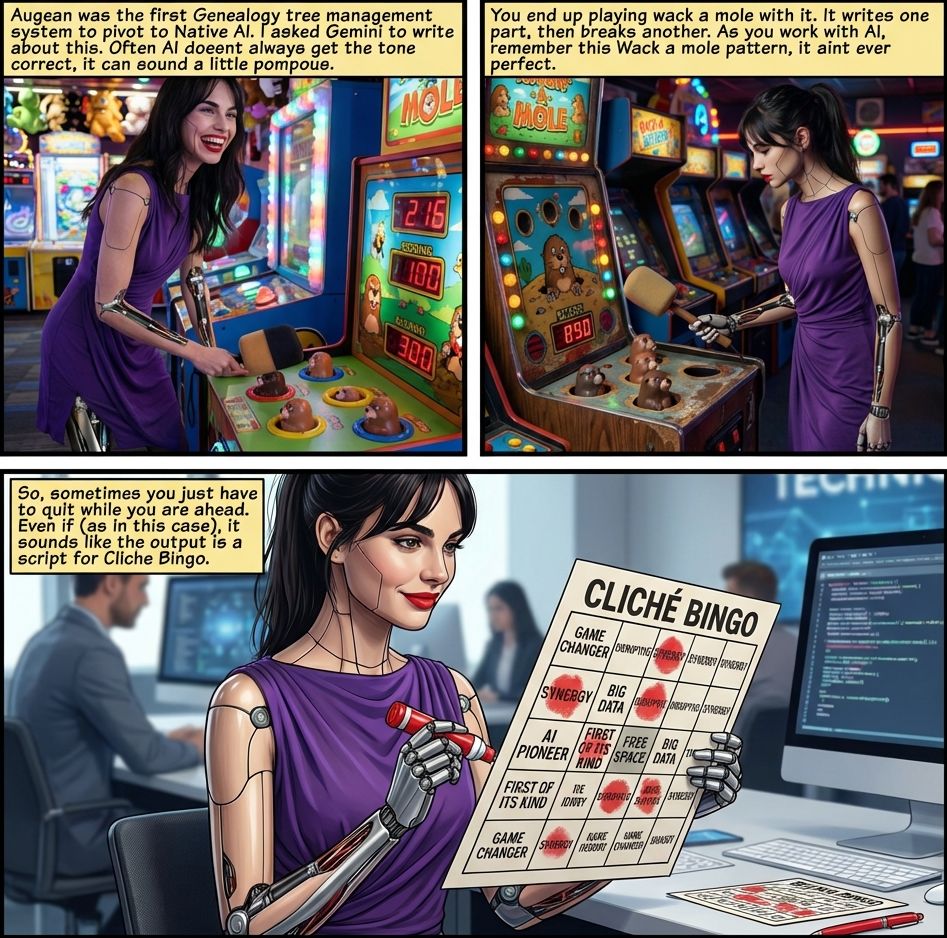
Augean was the first Genealogy tree management system to pivot to AI Native
I asked Gemini to write about this (see below)
Often AI doesnt always get the tone correct, sometimes it can sound a little pompous.
You may end up playing whack a mole with it.
AI writes one part, then breaks another.
As you work with AI, remember this 'whack a mole' pattern, it aint ever perfect.
Sometimes you just have to quit while you are ahead.
Even if (as in this case), it sounds like the output is a script for Cliche Bingo.
The Native AI Pioneer
2026 Technical Retrospective
<System Status: AI-Native / Context: Unlimited / Era: 2026>
In the history of technology, there is always a "Before" and an "After."
For the longest time, genealogy software existed in a comfortable, settled valley. It was the era of the Relational Database. The rules were clear: you typed data into a form, the software saved it into a table, and if you were lucky, it gave it back to you exactly as you typed it. It was a passive world. The software was a container, nothing more.
Then came "The Shift." The moment when Large Language Models (LLMs) gained the ability to hold vast amounts of information in their "Context Window."
While the rest of the industry stayed in the valley, simply adding "Chat" buttons to their existing filing cabinets, Augean chose to pack its wagons. We realized that you cannot explore a new frontier with old maps. To truly harness the power of this new intelligence, we couldn't just patch the software. We had to rebuild it.
The Great Architectural Schism
From our vantage point in 2026, the difference between "AI Enhanced" and "AI Native" is obvious. But to understand why Augean is different, you have to look at the code structure itself.
The Old Way: "Bolt-On"
Most legacy applications are built on SQL Databases. These are rigid grids. To use AI, they have to use a method called RAG (Retrieval-Augmented Generation).
Think of this like looking at a mural through a drinking straw. The software grabs one record (John Smith), converts it to text, and sends it to the AI.
- ❌ Limited Scope: The AI can't see John's neighbors.
- ❌ No Logic: It can't spot contradictions in the wider tree.
- ❌ High Friction: It requires constant translation between SQL and Text.
The Augean Way: "Native"
We threw out the SQL grid. Augean is architected around the Graph and the Stream.
Instead of sending "one record," Augean streams the entire family branch directly into the AI's Context Window. This allows the AI to hold the whole family structure in its "working memory" at once.
- ✅ Holistic View: The AI sees the forest and the trees.
- ✅ Deep Reasoning: It spots complex logical errors across generations.
- ✅ Zero Translation: The data flows natively.
GEDCOM: The Unexpected Native Tongue
Here is the technical secret that enabled our pivot: GEDCOM is not just a file format. It is a language.
For decades, developers fought against GEDCOM. They tried to hide it behind shiny buttons and proprietary database blobs. But when the AI revolution arrived, we realized that GEDCOM (specifically version 5.5.1) was actually the perfect protocol for communicating with Large Language Models.
// Why LLMs love GEDCOM
0 HEAD ...
1 INDI @I1@
2 NAME John /Smith/
2 BIRT
3 DATE 1850
1 FAM @F1@
2 HUSB @I1@
Why this matters: Proprietary databases are binary "black boxes." An AI cannot read them without a translator. GEDCOM, however, is text-based, hierarchical, and semantic.
Because LLMs are trained on billions of lines of text, they "understand" the grammar of GEDCOM intuitively. Augean was the first app to stop fighting GEDCOM and start using it as a direct communication stream with the AI. We don't translate your data; we let the AI read the original source code of your family history.
The Browser as the Canvas
Re-architecting the backend wasn't enough. We also had to change how you see your data.
Legacy apps are built on desktop frameworks that were designed in the 90s. They are static. If you want to change the view, you have to write new code, compile it, and ship an update.
Augean moved the entire display engine to the Web Browser DOM (Document Object Model).
Why? Because the DOM is fluid. When our Native AI suggests a new way to visualize a complex intermarriage or a migration pattern, it can literally write the code to display that chart in real-time. The browser allows Augean to be as dynamic as the AI itself. It is a living canvas, not a static form.
Proof in the Digital Sediment
In the digital age, history is written in server logs.
We don't ask you to take our word for it. The Internet Archive (Wayback Machine) serves as the impartial judge of the timeline. If you look back at the records, you will see a distinct divergence.
While the industry was largely focused on maintaining the status quo, the Augean repository shows a massive structural shift—a pivot away from "Data Management" and toward "Agentic Research."
We were the quiet ones in the back of the room, rewriting the kernel while everyone else was painting the interface. That early pivot is what gives Augean its "Native" advantage today. We have been living in this new world longer than anyone else.