Introduction: From Search to Solution
For decades, the digital genealogy workflow has remained fundamentally unchanged: a human researcher queries a database, reviews a list of potential matches, evaluates evidence, and manually enters data into a tree. This is a passive retrieval model. The software waits for input, and the cognitive load of synthesis rests entirely on the user.

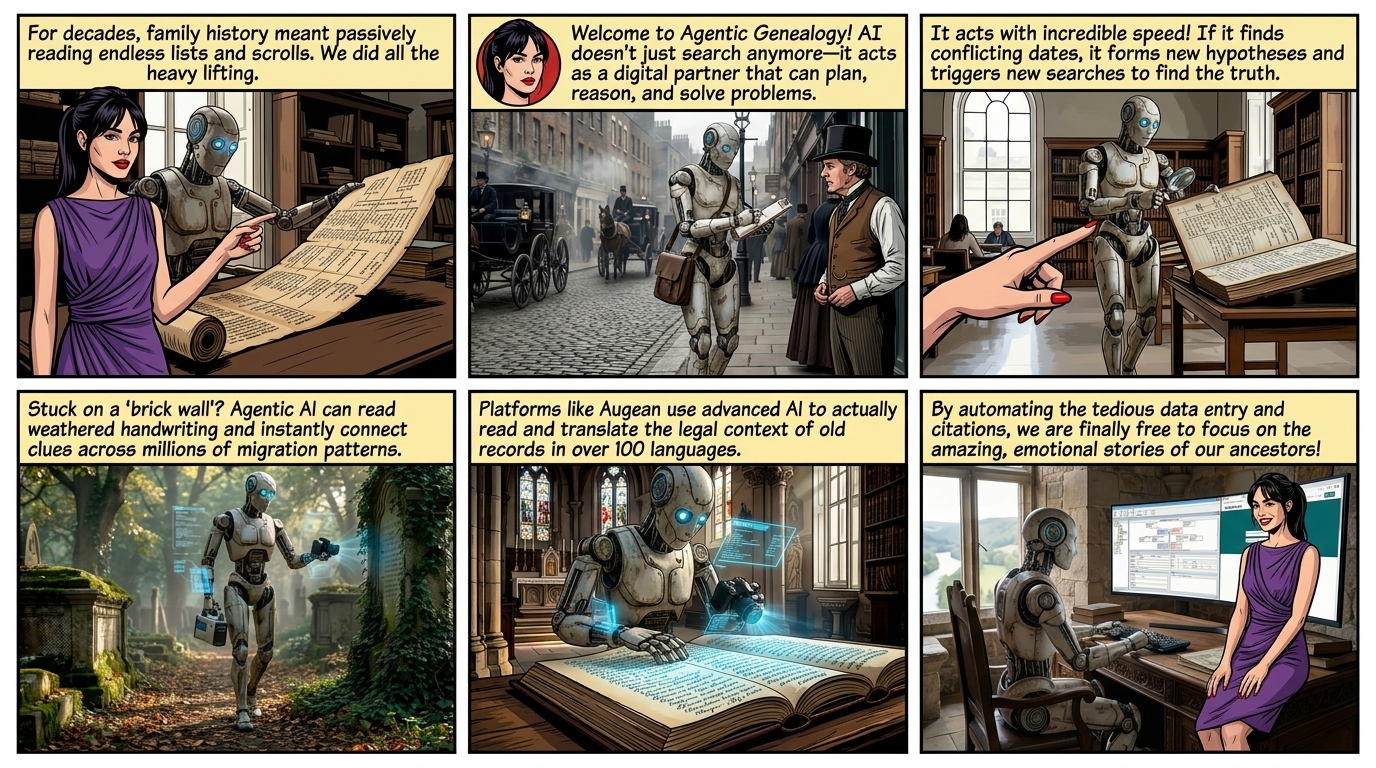
We are now entering the era of Agentic Genealogy. This paradigm shift moves us from using AI as a tool (like a better search engine) to deploying AI as an agent—an autonomous entity capable of planning, reasoning, and executing multi-step research workflows. Agentic genealogy does not merely retrieve documents; it solves problems. It transitions the genealogist from a data gatherer to a research director, overseeing a digital partner that understands not just who you are looking for, but how to prove they exist.
The Architecture of Agency: How It Works
In technical terms, an "agent" differs from a standard Large Language Model (LLM) in its loop of operation. A standard LLM generates text based on a prompt. An agent, however, operates on a Perception-Reasoning-Action loop:

• Goal Decomposition: The agent receives a high-level objective (e.g., "Identify the parents of John Smith, born 1850 in Ohio, and resolve conflicting birth dates"). It breaks this into sub-tasks: search census records, validate against baptismal logs, and cross-reference land deeds.
• Tool Use: Unlike a closed chatbot, an agent has "hands." It can query APIs, scrape specific repositories, or access graph databases.
• Recursive Reasoning: If an agent finds a record that contradicts known data (e.g., a death date before a child’s birth), it does not simply hallucinate a fix. It recognizes the conflict, formulates a new hypothesis, and triggers a new search to resolve the anomaly.
This is the application of the Genealogical Proof Standard (GPS) at algorithmic speed. The agent conducts a reasonably exhaustive search, cites sources, analyzes data correlations, and resolves conflicts before presenting a conclusion.

The Human Benefit: Scaling the Brick Wall
The primary value of agentic genealogy lies in its ability to scale high-quality research.
• Pattern Recognition at Scale: A human researcher might miss a connection between a 19th-century naming pattern and a migration route. An agent, trained on millions of migration vectors, can statistically infer that a family moving from Virginia to Kentucky likely followed specific kinship networks, prompting it to search neighbors' records—a strategy known as "cluster genealogy" (or the FAN club method), executed automatically.
• Breaking Brick Walls: Most "brick walls" are not due to a lack of records but a lack of indexed connections. Agentic AI can read handwriting via OCR, understand semantic context (e.g., identifying "Jno" as "John"), and synthesize fragmented evidence that would take a human years to piece together.
• Objectivity and Validation: Confirmation bias is a genealogist's greatest enemy. Agentic tools can be instructed to act as "Devil’s Advocates," specifically hunting for evidence that disproves a user’s theory, ensuring that the final tree is robust and evidence-based.

The Augean Paradigm: Integration with Gemini
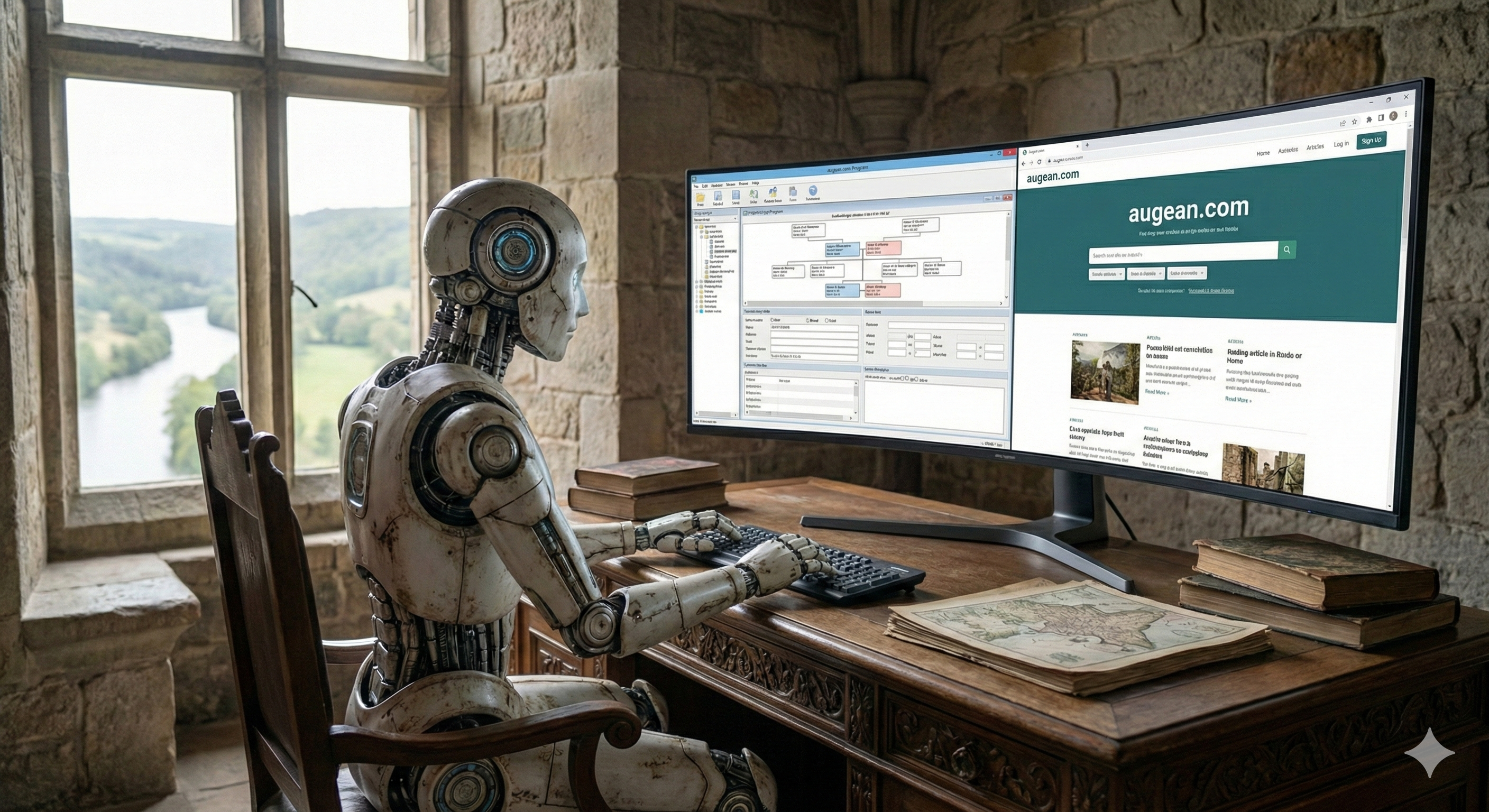
Leading this technological frontier are platforms like Augean.com, which represent the practical implementation of agentic principles. Augean differentiates itself by moving away from simple lineage charts to a Source-Centric architecture, powered by deep integration with Google’s Gemini models.
Augean utilizes Gemini’s massive context window and reasoning capabilities to ingest entire archives of family data simultaneously. Instead of analyzing one document in isolation, Gemini can "read" a user’s entire event stream—births, moves, land sales—and contextualize new evidence against that whole history.

• Contextual Transcription & Translation: Augean leverages AI not just to transcribe old handwriting but to translate and interpret the legal meaning of documents in over 100 languages, making international research accessible.
• Visualizing the Network: By integrating 3D graphics (via Babylon JS) and vector charts, Augean allows the AI to visualize its findings. It renders complex family interconnections not as flat lists, but as dynamic networks, helping technical genealogists see the "shape" of the data.
• The Agentic Workflow: In Augean, the user does not just click "search." They engage in an interactive loop where Gemini suggests the next best research step, drafts Genealogical Proof Reports, and even automates the tedious entry of citations.
Conclusion
Agentic genealogy is not about replacing the joy of discovery; it is about removing the friction of bureaucracy. By offloading the grunt work of sorting, citing, and verifying to platforms like Augean, genealogists are free to focus on the narrative and emotional truth of their ancestors' lives. We are no longer just searching for names; we are collaborating with intelligence to resurrect history.
Please read our blog on Augean and Agentic AI